
Video transcript
Does scrambler therapy work for nerve pain? Non-invasive nerve stimulation, cleared by the FDA. In studies: about 10 sessions, 30–45 minutes. Strongest evidence: chemotherapy neuropathy. Not studied with pacemakers, epilepsy or pregnancy. Start with a consultation and exam. Request a Ring Dinger® consultation with Dr. Terry J. Tolle, DC, Fishers, Indiana. ringdingerchiropractic.com, (317) 548-1020.
Scrambler therapy is a non-invasive, FDA-cleared nerve stimulation treatment, used for chronic nerve pain. Small electrodes go on the skin near the painful area, not on it, and a typical course is about 10 daily sessions of 30 to 45 minutes. Small trials, mostly in chemotherapy-induced neuropathy, report meaningful relief for many patients, but a sham-controlled trial found no difference from sham. Results vary, and the trials left out people with pacemakers, epilepsy or pregnancy.
Below you will find what each published trial found, which kinds of neuropathy have the most evidence, what a session feels like, and how Dr. Terry J. Tolle, DC, decides at Ring Dinger® Chiropractic whether Calmare® Therapy fits your case. Calmare® is a brand name for the MC5-A scrambler device that several of the U.S. studies used.
What is scrambler therapy, and how is it different from a TENS unit?
Scrambler therapy is a skin-surface nerve stimulator, the same broad kind of device as a TENS unit, but it is built to change how your nervous system reads pain rather than to cover pain up while the machine is running. A 2023 systematic review in Neuromodulation notes that it has 510(k) clearance from the U.S. Food and Drug Administration for acute pain, postoperative pain and intractable chronic pain. Cleared is not the same as approved: a 510(k) clearance means the FDA found the device comparable to one already on the market, not that a large trial proved it works for neuropathy.
The theory goes like this. Long-lasting nerve pain can become a habit of the nervous system, so the brain keeps reading an area as painful even when the original injury has settled. The scrambler device sends a pattern of signals the researchers call "non-pain" information through healthy nerves that serve the same area. Over repeated sessions, the idea is that the brain relearns that area as not painful. Dr. Tolle describes Calmare® Therapy as retraining pain signaling rather than blocking it.
That mechanism is still a theory. Nobody has proven exactly why some people respond and others do not. What is clearer is the practical difference from a TENS unit:
- Goal. A standard TENS unit creates a tingle that can mask pain while it is on. Scrambler therapy aims for relief that lasts longer after each session.
- Who runs it. TENS units are often used at home. Scrambler therapy in the studies was given in a clinic by a trained operator, and the authors of a 2016 review call it "operator-dependent".
- Electrode placement. Scrambler electrodes go on skin with normal feeling next to the pain, not on the painful spot itself.
What do the studies actually show for neuropathy?
The results are encouraging but early: most studies are small, follow-up is short, and the only fully published sham-controlled trial in chemotherapy neuropathy found no difference from sham (an earlier, smaller one reported only as a conference abstract also found none). Here is each key study side by side, with numbers taken only from the published abstracts.
| Study | Who was treated | Design | Size | What it found |
|---|---|---|---|---|
| Pachman 2015 (Mayo Clinic) | Adults with chemotherapy neuropathy for 1+ month, tingling or pain 4/10 or worse | Single-arm pilot, no comparison group | 37 patients | Pain down 53% by day 10, tingling down 44%, numbness down 37%. Benefit appeared to last through 10 weeks. No substantial adverse events. |
| Loprinzi 2020 (Mayo Clinic) | Adults with chemotherapy neuropathy for 3+ months | Randomized: scrambler therapy vs TENS for 2 weeks | 50 patients (46 evaluable) | At least 50% improvement in 36% to 56% of scrambler patients, depending on the symptom, vs 16% to 28% with TENS. Minimal side effects. |
| Smith 2020 (Johns Hopkins) | Adults with chronic chemotherapy neuropathy | Randomized, sham-controlled pilot (sham electrodes on the low back) | 35 patients (33 with pain data) | No significant difference from sham at day 10, 28, 60 or 90. Some people responded during treatment, but most of that faded by about day 30. |
| Majithia 2016 review | Many chronic pain conditions | Review of published reports | 20 reports | All but one small study looked positive. Only 3 of the 20 were randomized. The authors call for larger randomized trials and warn that negative results may go unpublished. |
| Karri 2023 systematic review | Chronic pain, nearly all nerve pain | Systematic review | 21 studies (8 randomized) | Safe and well tolerated. Evidence most robust for chemotherapy neuropathy. Most studies were small. Follow-up ran from 10 to 14 days up to 3 months. |
The best head-to-head result so far comes from a Mayo Clinic trial that compared scrambler therapy with TENS, where about twice as many scrambler patients had their pain, tingling or numbness cut at least in half during the two treatment weeks. Patients in the scrambler group were also more likely to say they would recommend it.
The Johns Hopkins sham trial points the other way, and it deserves equal weight. Its authors listed several possible reasons: the treatment may not work, the sham may have had some effect of its own, the group was small and mixed, or electrodes may have been placed over damaged but non-painful nerves. Any of those could be true.
So the fair summary is this: scrambler therapy is promising, has a good safety record in the trials, and has not yet been proven in a large, well-controlled study. Anyone who quotes you a single high success rate without naming the study is skipping that part.
Which kinds of neuropathy have the most evidence?
Chemotherapy-induced peripheral neuropathy has by far the most research behind it; diabetic and other kinds of neuropathy have thinner, mostly uncontrolled evidence. That matters because peripheral neuropathy is not one disease. Its causes range from diabetes and cancer treatment to immune disorders, inherited conditions and physical injury, including slipped discs pressing on nerves, as the National Institute of Neurological Disorders and Stroke explains.
| Cause | What has been studied | How strong it is |
|---|---|---|
| Chemotherapy neuropathy | Single-arm pilots, a randomized trial against TENS and a sham-controlled pilot | Strongest of any use, but still small studies with mixed results |
| Diabetic neuropathy | Little published research of its own; the Johns Hopkins sham trial and an early Mayo Clinic study excluded people with diabetes-related neuropathy | Limited. It has not been tested in a large controlled trial. |
| Other nerve pain (shingles pain, spine-related nerve pain, CRPS) | Small prospective studies, clinic case series and a few randomized trials | Early and mostly uncontrolled |
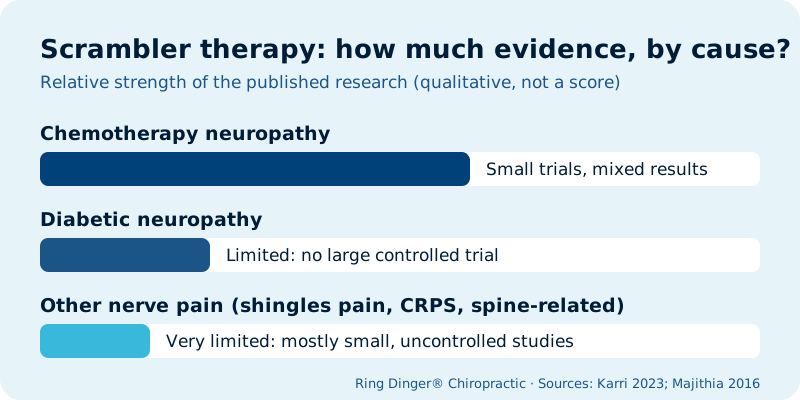
One detail is easy to miss. The Johns Hopkins sham trial and an early Mayo Clinic study both list exclusions, on ClinicalTrials.gov, for people whose numbness or pain could have another cause, including diabetes, vitamin B12 deficiency, thyroid disease and pinched nerves in the neck or low back. That kept the results clean, but it also means the best data does not tell us how diabetic neuropathy responds.
Complex Regional Pain Syndrome (CRPS) is part of Dr. Tolle's clinical focus, and scrambler therapy has been studied for it in small groups. It is a separate topic with its own evidence, and it gets its own post.
What happens during a scrambler therapy session?
You sit or lie comfortably while electrodes on the skin near your pain deliver a buzzing signal for 30 to 45 minutes, and the intensity is set so it should not hurt. Mayo Clinic and Johns Hopkins investigators described the usual protocol in a 2016 review:
- Map the pain. The provider marks where it hurts and finds nearby skin that still has normal feeling.
- Place the electrodes. They go on that normal-feeling skin, not on the painful spot. Up to five sets can be used if more than one area hurts.
- Adjust the intensity. It is turned up to what you find comfortable. When the placement is right, the pain sensation is usually replaced by the device sensation, which patients often describe as "pleasant, vibratory, and/or humming".
- Let it run. Once the settings are right, the device runs for 30 to 45 minutes.
- Repeat on weekdays. Sessions are usually given on consecutive weekdays, about 10 in all, though some people need fewer and some need more.
The same review says relief after the first session usually lasts only a short time. With each session, the pain-free stretch tends to grow longer. If pain comes back weeks or months later, one or two booster sessions may bring the benefit back.
At Ring Dinger® Chiropractic, Dr. Tolle sets your plan after the exam. The number of sessions and how they are spaced depend on your diagnosis, your response and your schedule, so your count is set after the exam.
Who is not a good candidate for scrambler therapy?
People with certain implanted devices, recent heart problems, seizure disorders or pregnancy were left out of the research. Bring this list to your consultation so these can be discussed. The list below comes from the exclusion rules of two registered trials, the Johns Hopkins sham-controlled trial and an early Mayo Clinic study. It shows who the research did not include. It is not the device maker's official warning list, and your own history may raise other questions.
- Pregnancy (one trial also excluded nursing mothers)
- A pacemaker, implanted defibrillator, cochlear implant, aneurysm clips, vena cava clips, heart stents or skull plates. Orthopedic pins, plates, cages and joint replacements were allowed.
- An implanted drug pump
- A heart attack or ischemic heart disease in the past six months
- Epilepsy, brain damage or cancer that has spread to the brain and is causing symptoms
- Open sores or skin problems where the electrodes would go
- A past allergic reaction to TENS, or being unable to tolerate it
Scrambler therapy also assumes you know why your nerves hurt. Neuropathy needs a diagnosed cause first, because some causes, like low B12 or poorly controlled blood sugar, need their own treatment. If you have diabetes, keep up with your medical doctor's foot checks. The National Institute of Diabetes and Digestive and Kidney Diseases warns that numb feet may not notice injuries that turn into sores, and it advises checking your feet every day.
Some symptoms can't wait for a consultation. Go to the ER or call 911 for sudden weakness in an arm or leg, loss of bladder or bowel control, or numbness in the groin or inner thighs. See your medical doctor promptly for numbness or weakness that is new or getting worse, or for any foot wound that is not healing.
Do I have to stop gabapentin or pregabalin first?
Not on your own: some trials stopped these drugs first, but only the doctor who prescribed them can decide that. The question comes up because the 2016 review says clinical experience suggests poorer results when anticonvulsant pain medicines are not stopped first, and the Johns Hopkins trial names gabapentin (Neurontin) and pregabalin (Lyrica) as examples.
The trials handled this carefully. An early Mayo Clinic Scrambler study registered in 2011 excluded anyone taking anticonvulsants. The Johns Hopkins trial weaned participants off these drugs before treatment, using instructions from the study team. The same review notes that whether stopping is truly necessary still needs to be studied.
If you take one of these medicines, bring the name and dose to your consultation. Dr. Tolle will talk with you about it and coordinate with your prescriber. Any change to your medication stays in your prescriber's hands.
How does Ring Dinger® Chiropractic decide whether Calmare® Therapy fits you?
Every patient starts with a consultation, a health history and an exam before any treatment, and Calmare® Therapy is offered only when it fits the cause of your pain. You can read about Dr. Tolle's training in Calmare® Therapy and his other credentials on his profile. He has practiced chiropractic in central Indiana for more than 20 years, and his clinical focus is nerve and disc injury: peripheral neuropathy, CRPS and disc-related spinal pain.

At the visit, Dr. Tolle reviews what you bring, including the list from the section above. He looks at where the pain sits, what it feels like and what has already been tried. Imaging such as X-rays or an MRI helps if you have it.
Part of the exam is working out where the nerve problem starts. Burning or numb feet can come from damaged nerves in the feet themselves, but leg symptoms can also come from a pinched nerve or a disc in the low back. Nerve pain that starts in the spine is a different problem with different options, and the exam is how the two get sorted out. You can read how The Ring Dinger® approaches spine-related nerve pain on its own page.
For nerve pain, Dr. Tolle may combine Calmare® Therapy with Piezowave2® shockwave therapy and chiropractic care. If he doesn't think scrambler therapy is likely to help your case, or one of the screening items rules it out, he will tell you plainly and talk through other options, including seeing your medical doctor.
In the studies the course ran on consecutive weekdays, so if Dr. Tolle recommends it, ask how many visits your plan involves. Our Fishers clinic, northeast of Indianapolis, is an easy drive from Carmel, Noblesville and Westfield, which helps when visits fall on back-to-back weekdays. Results vary from person to person, and the consultation is where you get an honest read on whether this treatment makes sense for you.
Sources
- Pachman DR, Weisbrod BL, Seisler DK, et al. Pilot evaluation of Scrambler therapy for the treatment of chemotherapy-induced peripheral neuropathy. Support Care Cancer. 2015;23(4):943-951. doi:10.1007/s00520-014-2424-8. PMID 25245776.
- Smith TJ, Razzak AR, Blackford AL, et al. A pilot randomized sham-controlled trial of MC5-A Scrambler therapy in the treatment of chronic chemotherapy-induced peripheral neuropathy (CIPN). J Palliat Care. 2020;35(1):53-58. doi:10.1177/0825859719827589. PMID 30714486.
- Loprinzi C, Le-Rademacher JG, Majithia N, et al. Scrambler therapy for chemotherapy neuropathy: a randomized phase II pilot trial. Support Care Cancer. 2020;28(3):1183-1197. doi:10.1007/s00520-019-04881-3. PMID 31209630.
- Majithia N, Smith TJ, Coyne PJ, et al. Scrambler Therapy for the management of chronic pain. Support Care Cancer. 2016;24(6):2807-2814. doi:10.1007/s00520-016-3177-3. PMID 27041741. PMCID PMC4973603.
- Karri J, Marathe A, Smith TJ, Wang EJ. The use of Scrambler therapy in treating chronic pain syndromes: a systematic review. Neuromodulation. 2023;26(8):1499-1509. doi:10.1016/j.neurom.2022.04.045. PMID 35691908.
- National Institute of Neurological Disorders and Stroke (NINDS). Peripheral Neuropathy. National Institutes of Health.
- National Institute of Diabetes and Digestive and Kidney Diseases (NIDDK). Peripheral Neuropathy. National Institutes of Health.
- ClinicalTrials.gov. NCT01290224: MC5-A Scrambler Therapy in Reducing Peripheral Neuropathy Caused by Chemotherapy (Mayo Clinic). NCT02111174: Scrambler Therapy in the Treatment of Chronic Chemotherapy-Induced Peripheral Neuropathy (Johns Hopkins). Eligibility criteria.
Frequently asked questions
Does scrambler therapy hurt?
It shouldn't. The intensity is raised only to a level you find comfortable, and in the published protocol a well-placed session replaces the pain with a buzzing or humming feeling that many patients call pleasant. The electrodes sit on skin with normal sensation, not on the sore spot. If a setting feels sharp or painful, say so right away: the provider adjusts the intensity or moves the electrodes, because a session is meant to be pain-free.
How soon can you tell if scrambler therapy is working?
It differs by person, so there is no set point. Investigators at Mayo Clinic and Johns Hopkins describe relief after the first session that usually lasts only a short time, then lasts longer after each visit that follows. In the Johns Hopkins sham-controlled pilot, some people responded during treatment but most of that faded within a month. Track your pain each day so you and Dr. Tolle can judge it honestly.
How long does relief last after a course of treatment?
Nobody knows for sure yet. In the 21 studies a 2023 systematic review examined, follow-up ran from 10 to 14 days up to about three months, so longer relief is mostly reported from clinical experience, not trials. The Mayo pilot saw benefit through 10 weeks. When pain returns, the 2016 review describes one or two booster sessions that may restore the earlier benefit, but results vary.
Is scrambler therapy covered by insurance?
Often it is not. A 2016 review by the researchers who study it noted that some insurers won't pay for scrambler therapy because the evidence is still limited, while others have started to cover it. Coverage depends on your plan, so don't count on it. Ring Dinger® Chiropractic explains the cost and your options at the consultation, before any treatment begins.
Can I do scrambler therapy at home?
Not in the form the research tested. Every trial used clinic-delivered sessions given by a trained operator who maps the pain, places the electrodes and adjusts the device during each visit. The 2016 review calls results operator-dependent. A home TENS unit is a different device with a different goal: it masks pain while it runs. In the Mayo trial that compared the two, TENS did worse.
Can scrambler therapy help CRPS?
It has been studied for Complex Regional Pain Syndrome in small case series and clinic reports, not in large controlled trials. CRPS is one of Dr. Tolle's areas of clinical focus, but whether Calmare® Therapy fits your case depends on your history and exam. Bring your diagnosis and treatment records to the consultation, and keep your medical doctor or pain specialist involved.
Ready to find out if The Ring Dinger® is right for you?
Request an Appointment